
Income Protection for High-Income Earners: A Guide for Australian Professionals in their Peak-Earning Years
By the time most professionals reach their 40s and 50s, they are earning more than they ever have, have dependants who rely on those earnings, and still have a mortgage to clear. A well-structured income protection policy is the difference between an illness or injury becoming a 12-month disruption versus a long-term financial collapse. After the 2021 APRA reforms, that policy looks materially different from what advisers were writing five years ago.
This article is the first in a Personal Insurance series. It focuses on a specific audience: Australian professionals in their peak-earning years, with families, mortgages, and a long enough runway to retirement that an income-loss event has consequences measured in hundreds of thousands — in some cases millions — of dollars rather than tens. We chose this audience deliberately because the standard advice you find in retail comparison sites — usually written for the median earner with simple circumstances — rarely fits a household in this shape.
We will cover what changed in October 2021 and why it matters, how to think about the right level of cover, the inside-super versus outside-super decision, the waiting-and-benefit period trade-offs, and the tax treatment of both premiums and benefits. As always: this is general information, not personal advice. Speak to a licensed financial advisor who has specifically considered your situation before changing any existing insurance arrangement.
For high-income earners, income protection insurance replaces up to 70% of your pre-disability earnings if illness or injury stops you working — but two structural issues bite hardest at high incomes. First, since the October 2021 APRA reforms the maximum insurable amount is capped at 70% of earnings (down from 75%), and insurers apply a maximum monthly benefit that varies by product — so a professional earning well above the average often finds a standard policy caps out below 70% of their actual income. Second, default cover inside your super fund is usually a long way below what a high income needs. The high-income planning task is to size cover to the real income, choose the right waiting and benefit periods, and decide whether to hold the cover inside or outside super for the best tax and cash-flow outcome.
| Design element | What high earners need to know |
|---|---|
| Maximum cover | Up to 70% of pre-disability earnings (post-October 2021); up to 90% allowed for the first six months on some policies |
| Monthly benefit cap | Applied by the insurer and varies by product — standard policies often cap below a high earner’s actual 70%, so higher-cap products may be needed to fully insure the income |
| Benefit ceiling | The benefit can never exceed your actual income — you cannot profit from a claim |
| Own vs any occupation | Many post-2021 policies limit own-occupation cover to ~2 years before an any-occupation test applies — the most material change for specialists |
| Tax | Outside-super premiums generally tax deductible; benefits taxed as assessable income at your marginal rate |
Who this article is written for
This article is written for Australian professionals in their peak-earning years whose households would be materially compromised by a long income-loss event. The audience is defined less by a single dollar threshold and more by life stage and household shape — by what would be lost if the primary earner could not work for 12 months or longer.
The typical reader of this article is:
- Aged 40 to 60 — in or approaching peak earnings, with 5 to 25 working years to go before a meaningful retirement option opens up.
- The primary or co-primary breadwinner in a household with dependants — partner, children, or both.
- Carrying a mortgage or other long-term debt that depends on continued earning capacity to service.
- Earning enough that a 70% income replacement materially shapes the household budget — not because of the wages alone, but because the lifestyle, schooling commitments, and mortgage servicing are calibrated to the current income.
There is no single dollar threshold that defines "high income" in Australia — the right marker depends on which authority is doing the defining. For context:
- The Fair Work Commission high-income threshold (used for unfair-dismissal eligibility and contractor rules) is A$175,000 for the 2024-25 year and rises to A$183,100 from 1 July 2025. This is the most commonly cited statutory marker for "high income earner" in Australian employment law.
- The top 10% of individual earners in Australia sat at roughly A$137,000 and above on the 2022 ABS Personal Income in Australia data. (The figure drifts up each year with wage growth.) The same ABS data reports the median individual income at around A$55,000-58,000 — which gives some sense of how different the planning conversation is for the top decile.
- For Canberra public servants specifically, senior paypoints such as EL2 and SES Band 1 are broadly at or above the Fair Work high-income threshold, though the exact figures vary by agency — meaning a meaningful share of Véurr’s local APS audience reaches high-income-threshold territory by mid-career.
If you sit in that life stage and household shape, the income protection decision matters more for you than for the population at large — and the post-2021 rule changes affect you more than they affect a younger or lower-income reader.
What changed in October 2021 — the APRA sustainability reforms
For five years to 2020, the Australian individual disability income insurance (IDII) market — the formal name for income protection — lost roughly A$3.4 billion, because premiums were under-priced for the claims insurers were paying out. APRA, the prudential regulator, intervened. From 1 October 2021, new policies (and many renewed or restructured policies) became subject to APRA’s IDII sustainability measures, which materially changed the cover available to high-income professional households.
The headline changes:
| Element | Pre-October 2021 | Post-October 2021 |
|---|---|---|
| Maximum income replacement | Up to 75% of pre-disability earnings (sometimes higher with agreed-value structures) | Up to 70% of pre-disability earnings (up to 90% allowed for the first six months on claim) |
| Own occupation benefit period | Could be paid for the full benefit period (often to age 65) | Many policies cap the own-occupation period at around two years before any-occupation assessment — now varies by insurer |
| Pre-disability earnings basis | Highest 12-month period over a longer look-back (commonly 2-3 years) | The 12 months immediately before disability |
| Policy contract term | Often guaranteed renewable for life | Largely unchanged — APRA’s proposed 5-year contract-term measure was suspended in March 2022; cover generally remains guaranteed renewable |
Each of these has different implications for the high-income professional household.
The 70% cap and what it means for households with calibrated lifestyles
A household earning A$300,000 a year pre-disability can now insure a benefit of approximately A$210,000 (70%) annually under a new policy. For most households, that 30% gap between gross earnings and insurance benefit is what they need to plan around — the mortgage, the family, and the lifestyle were all calibrated to the full income. The gap can be bridged by other insurances or by deliberate "self-insurance", and a conversation with a financial adviser before any claim arises often surfaces options that suit your specific circumstances.
The own-occupation definition and why it matters
Under the old rules, a specialist surgeon who could no longer operate, or a senior executive who could no longer meet the cognitive demands of their role, could potentially be paid an own-occupation benefit for the full benefit period — even where they could theoretically perform some other less-demanding occupation. Following October 2021, many policies cap that own-occupation protection at around two years (though this varies by insurer). After that point, the insurer can assess whether the claimant could perform any occupation for which they are reasonably suited by training and experience — and if yes, benefits stop or are reduced.
For high-income specialists, this is the single most material adverse change in the reforms. It does not mean the cover is unworkable; it means the planning conversation has to include a clear-eyed view of what happens when own-occupation cover converts to any-occupation, and whether the household has the asset base to bridge from there.
This change is also a reason why policies that were put in place before the reforms should be reviewed by a specialist financial adviser before they are cancelled. If the premiums are getting costly, there are options that could allow you to retain pre-2021 benefits at a lower cost, which your adviser could outline.
The structural review cycle
APRA proposed replacing lifetime guaranteed renewability with five-year contract terms, but suspended that measure in March 2022 — so most cover today remains guaranteed renewable. Even so, a disciplined review cycle remains good practice: revisit your cover against your circumstances every few years, regardless of how the contract is structured.
How much cover do you actually need?
The post-2021 cap is 70% of pre-disability earnings, but the right level of cover for any specific household can be lower — not because anyone aspires to under-insure, but because the household has other resources (emergency savings, accrued leave, asset base, and other insurance such as Trauma and Total and Permanent Disability cover).
A useful framing is to treat the income protection benefit as the resource that funds the household’s essential and committed outgoings during a claim, while the household’s own resources fund the discretionary and flexible outgoings. Essential and committed includes:
- Mortgage principal and interest (at the worst-case interest rate, not the current one)
- Dependant living costs (groceries, school fees, healthcare, childcare)
- Insurance premiums (the rest of the household’s insurance program, which continues to run)
- Utility and connectivity costs
- Health-related costs that may rise during a disability claim
Some income protection policies also have a feature that continues contributions to your superannuation even while you are not working — building your retirement savings so they are there at the point the income protection benefit stops paying.
Inside super or outside super?
This is the structural decision most professional households get wrong, usually because the default cover bundled with their super fund feels like a free benefit and is left in place without analysis.

Why inside-super is the default — and why it is rarely the right structural answer for a high-income professional
Inside-super cover is the default because every Australian with super contributions has a default super fund, and that fund can include default insurance. The premium is invisible to the household cash flow because it is funded from the super balance. The cover is therefore easy to forget.
The reasons it is usually not the right structural answer for a high-income professional household are: (1) the default monthly benefit cap is often a long way below the professional’s actual income; (2) the premium funded from super is a drag on the long-term retirement balance; (3) inside-super premiums are not personally tax deductible, whereas outside-super premiums are; (4) inside-super benefits are subject to super law conditions of release, which can delay payment in some claim scenarios; and (5) the inside-super cover is often less feature-rich than the outside-super equivalent (shorter benefit periods, less flexible occupation definitions).
The hybrid approach
Some households end up with a sensible hybrid: a base level of cover inside super (funded from super contributions, easy to maintain), topped up with an outside-super policy that brings total cover up to the right level for the household and captures the tax-deductibility on the marginal premium. The structure is more complex than a single policy and the policies need to coordinate at claim time, but for some professional households the hybrid is the right structural answer.
The decision between inside-only, outside-only, or hybrid is not a default — it should be made deliberately, with sight of the household’s full tax position, super balance, cash flow capacity, and other insurance arrangements. A financial adviser experienced in this area can help work it through.
Waiting period and benefit period — the two-lever trade-off
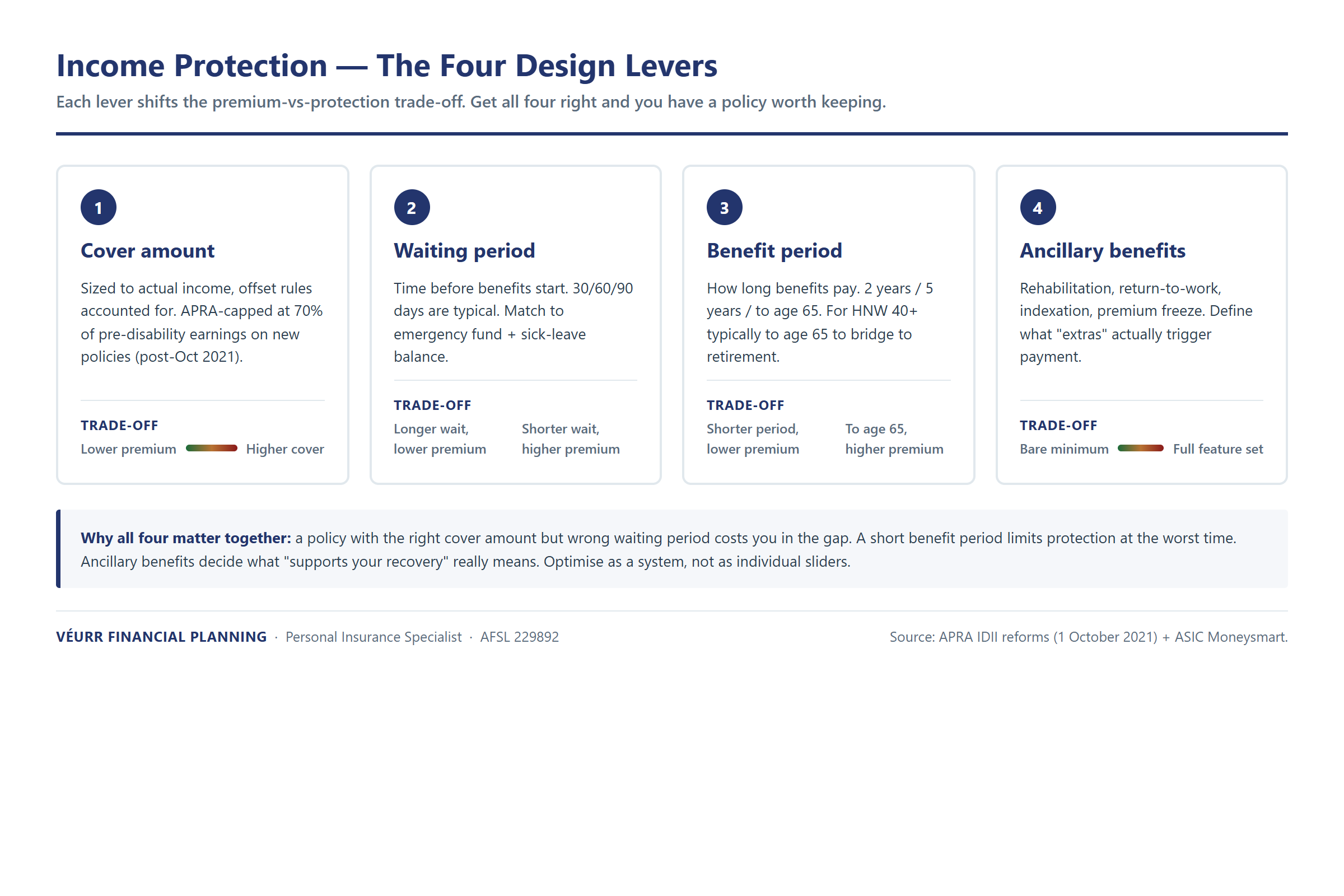
Once the cover level and the inside-versus-outside-super decision are made, two further levers materially affect both premium and protection: the waiting period and the benefit period.
Waiting period — how long before the policy starts paying
Standard waiting period options are 14, 30, 60, 90, 180 or 365 days (and can be longer in certain circumstances). The waiting period is the time the household must fund its own fixed costs from emergency savings, accrued sick leave, or other resources before the income protection benefit starts paying.
The premium curve is steep at the short end and flattens out: a 14-day waiting period costs noticeably more than a 30-day, which in turn costs more than a 90-day, but the gap between 90 and 180 days is usually narrower. For a household with a meaningful emergency buffer (three months of essential outgoings or more), a 90-day waiting period is often the cost-efficient choice. For a household with limited liquidity, a 30-day waiting period reduces the dependence on other resources but at a higher premium.
Benefit period — how long the policy keeps paying
The benefit period choice is binary in practice: either a fixed period (commonly two years or five years) or to a specified age (commonly age 65, though some policies offer age 70).
For a 45-year-old primary earner with a 20-year runway to retirement, a two-year benefit period is materially under-protective. A disability that lasts longer than two years — not a rare scenario in long-term claims — would leave the household without income for the remaining 18 years of the working life. Benefit-to-age-65 is more expensive but is the structurally appropriate choice for households where a long-term disability would otherwise compromise long-term retirement security.
For a 58-year-old with a short runway, substantial assets accumulated, and a clear retirement transition in sight, a shorter benefit period may be more cost-efficient because the marginal protection it provides over the remaining working years is materially less. The trade-off is specific to the individual, and a shorter benefit period is sometimes the right call where the circumstances negate the need for a longer one — something to work through with an adviser.
Tax treatment — premiums and benefits
Premiums
Income protection premiums paid from after-tax income on a policy held outside super are generally tax deductible to the policyholder. The deduction is allowed because the policy is designed to replace assessable income; the premium is therefore an expense incurred to derive assessable income.
Inside-super premiums are not personally tax deductible — the policyholder did not pay them from after-tax income. The superannuation fund itself may be able to claim the deduction at the fund level, but that does not reduce the policyholder’s personal taxable income. A hybrid structure would have one component that is tax deductible to the individual and another at the super fund.
Bundled policies (for example, income protection plus other personal insurances inside one contract) require the insurer to break down the premium so the policyholder only claims the income-replacement portion. Always confirm tax treatment with your accountant — outcomes depend on individual circumstances.
Benefits
Income protection benefits, when paid, are assessable income in the year of receipt. They are taxed at the policyholder’s marginal rate, similar to ordinary salary income. This is true whether the policy was held inside or outside super (the inside-super distinction affects the premium tax treatment, not the benefit tax treatment).
The practical implication: the 70% gross benefit cap translates to a smaller net replacement of after-tax income, because the tax outcome on the benefit is similar to the tax outcome on the original salary. For a household budgeting the actual cash flow protection the cover provides, the after-tax benefit is what counts, not the gross figure.
Common mistakes we see in professional households
Five recurring patterns appear in the income-protection arrangements of the professional households we review:
- Relying on inside-super default cover only. The default monthly benefit cap is often less than the policyholder’s actual income, and the policyholder is unaware of the gap until they review.
- Setting up adequate cover at age 35 and not reviewing it at age 45 or 55. Income, dependants, mortgage debt and asset base all change significantly across that 20-year span. A policy set up for someone earning A$80,000 a year is not the right policy for that same person 15 years later, earning A$175,000 with lifestyle and debt adjusted to the higher income.
- Choosing a short benefit period without understanding the long-tail risk. Two-year benefit periods look attractive in the quote comparison because the premium is materially lower. The household-level risk they leave on the table — a disability lasting past the two-year mark, in a primary-earner household with 15+ years of working life remaining — is the scenario the cover should have been designed for.
- Having no cover at all while healthy, then trying to apply after becoming ill or injured. Plenty of younger, healthier clients say they do not need this protection because they are healthy or work in a safe job — and then come back years later wishing they had taken out cover when they were younger and fitter, once their health has changed. No one knows what the future holds. This policy is exactly the one to put in place while you are healthy.
- Pre-October-2021 policies left unreviewed. Members with cover written under the older rules often have superior terms (longer own-occupation, higher replacement ratio) that they would lose if they changed policies. Restructuring such policies needs to weigh the value of the older terms against the reasons to change. Switching is sometimes right, but the decision should be deliberate — never made without speaking to a financial adviser experienced in this area.
When to engage a financial adviser on income protection
As soon as you are earning an income your lifestyle depends on, it is time to review your income protection needs. This article focuses on high-income earners from the age of 40, and if you have not had this conversation with a financial adviser experienced in this area — the kind of specialist financial planning in Canberra professionals rely on — the time is now, ideally well before you turned 40.
The earlier you have this conversation, the healthier you are likely to be, and the more comprehensive a policy the insurer can generally offer — compared with someone who already has health issues recorded in their medical history. It is striking how much even a small discussion with your GP can affect your insurability, and those events are less frequent in our 20s and 30s. You are also healthier in your 40s than your 50s, and healthier in your 50s than your 60s.
Earlier policies have also tended to be more comprehensive: the post-2021 reforms are not the first changes made to income protection in Australia, and we do not know what will drive future changes. Getting cover in place sooner at least locks in the benefits available today. It is equally prudent to review a pre-2021 policy to confirm it still suits you — small alterations need not make it less comprehensive, only more suitable, whether through lower premiums or by adjusting features you do not use.
We do not know what tomorrow brings — a cancer diagnosis, or a traffic accident through no fault of our own that leads to significant disability and a long recovery. That uncertainty is precisely why putting cover in place while you are well matters.
The bottom line: if you are earning an income your lifestyle depends on and have not yet engaged a financial adviser experienced in income protection, the question worth asking yourself is simply — why not?
Questions worth asking any adviser before engaging:
- Will you review my existing inside-super cover and outside-super cover together, and show me the gap to the structurally appropriate level for my household?
- How will you weigh the inside-versus-outside-super decision against my marginal tax rate, cash flow, and super balance?
- What is your view on benefit period for a household in my circumstances — and why?
- If I have a pre-October-2021 policy, how will you assess whether the older terms are worth preserving?
- What is your fee structure, and is your adviser status registered on the ASIC Financial Advisers Register?
Frequently asked questions
Is the 70% benefit cap calculated on salary alone or salary plus super?
The 70% is generally calculated on your earnings — your salary. Any super-contribution benefit is a separate allowance: APRA requires it to be paid directly into your super fund, so it does not increase the 70% paid to you. Definitions of pre-disability earnings vary by insurer, so always confirm the specific definition in the policy contract. Bonuses, commissions, and other variable income components may or may not be included depending on the policy.
What happens if I have a pre-October-2021 policy and I make a claim now?
The policy you held at the time of disability is the policy you claim against. If your contract was written before 1 October 2021 and has been continuously held (not restructured into a new contract), the original terms generally apply — including any features that are no longer available on new policies. Some pre-2021 policies have agreed-value benefit structures, longer own-occupation cover, or higher replacement ratios that are valuable to preserve. Restructuring an older policy means the new policy will be written to current rules.
Can I claim a tax deduction for premiums my employer pays on my behalf?
No. Tax deductibility follows the person who actually paid the premium. Where an employer pays the premium on behalf of an employee, the employer may be able to claim a deduction; the employee cannot. Where the premium is funded from salary sacrifice or from after-tax employee contributions, the deductibility outcome depends on the specific arrangement. The personal-deduction question is usually most relevant for self-employed professionals, contractors, and individuals who pay their own outside-super premiums from after-tax household income.
Do business owners need a different kind of cover?
Self-employed professionals and business owners often need a more carefully designed income protection program because the income definition is more complex (the policyholder’s salary plus the business profits attributed to their work), the bookkeeping of pre-disability earnings is harder to demonstrate to an underwriter, and the business itself may need separate cover (key person insurance, business expenses cover) that complements the personal income protection. Business owners typically benefit from a coordinated advice piece across personal and business insurances rather than separate policies bolted together.
What about specialist policies for doctors, dentists and other professionals?
Several Australian insurers operate professional-only or professional-focused product ranges — including mutual insurers that limit membership to qualified professional groups (medical specialists, lawyers, accountants, engineers, and similar). These products typically offer higher monthly benefit caps for high-income specialists, occupation definitions tailored to the specialty, and underwriting that recognises the longer training pathway and the higher income trajectory of the audience. Some mutual insurers also operate profit-share or dividend arrangements for long-standing members that can offset premiums over time; the specifics vary by insurer, so confirm them in the PDS. These products are not always the right answer — the underwriting can be stricter and the premium is not always lower — but they belong in the comparison set for specialist professional households.
How do I review existing cover without committing to change it?
A standard structured review with a licensed adviser does not commit you to changing any policy. The review should produce: a summary of your existing cover from all sources (inside super, employer group, retail standalone), the gap to the structurally appropriate level for your household, a view on whether older policies should be preserved or restructured, and a recommended action plan with explicit costs and implementation timelines. You can then decide whether to act on the recommendations. We do this for clients as a discrete piece of work without bundling it to a broader engagement.
Reviewing your income protection? Get it structured right.
Maciej and Imran at Véurr help professional households audit existing cover, identify the gap to the structurally appropriate level, and decide between inside-super, outside-super, and hybrid structures. We do this as a discrete piece of work without bundling it to a broader engagement.
No obligation. No product pitch.
Request a call back from Véurr here
Or call us directly: (02) 6171 1777
Sources and further reading: APRA — Sustainability measures for individual disability income insurance · APRA — Final individual disability income insurance sustainability measures · ATO — Income protection insurance deductions · Fair Work Commission — High income threshold · ABS — Personal Income in Australia · Moneysmart — Income protection insurance